Synthetic intelligence (AI) will both smash jobs or create new jobs — relying on which record you learn. Actually, it’s most likely slightly of each — AI will surely exchange human staff in some spheres, however it’ll additionally create new roles, a lot of which we will be able to’t but consider. A up to date record from PA Consulting, titled “Other people and machines: From hype to truth,” helps this principle and predicts AI is much more likely to create jobs than smash them.
The analysis in the back of this record, in accordance with 750 cross-industry companies within the U.Okay., discovered that 32% of respondents had invested in AI and automation within the closing 5 years, cut up flippantly throughout gear for cognitive and bodily duties. Of those who had invested, 43% reported an building up in jobs in consequence, whilst 40% reported a discount.
“Our analysis presentations AI and automation are prone to result in a web acquire in task numbers,” the record reads. “As some kinds of jobs disappear, new ones will emerge.” Those findings are supported in other places — the Group for Financial Co-operation and Construction (OECD) additionally predicts that whilst AI and automation will no doubt have an effect on jobs, there might be no web loss.
So what forms of glossy new jobs are we able to be expecting? Sweden’s Einride provides us some thought — the self sustaining trucking startup has introduced that it’s now hiring distant truck operators. The corporate expects to make its first rent in Sweden in March, adopted via equivalent hires within the U.S. later this 12 months.
“New transportation machine”
Einride, which has raised north of $30 million since its inception in 2016, has advanced the electrical T-pod, which it touts as a wholly “new transportation machine.” Every pod is round 23 ft in period and will cling 15 usual pallets and shuttle 124 miles on a unmarried fee. Maximum particularly, the T-pod isn’t an ordinary truck retrofitted to pressure itself — there’s no bodily area within the T-pod for a human to sit down.

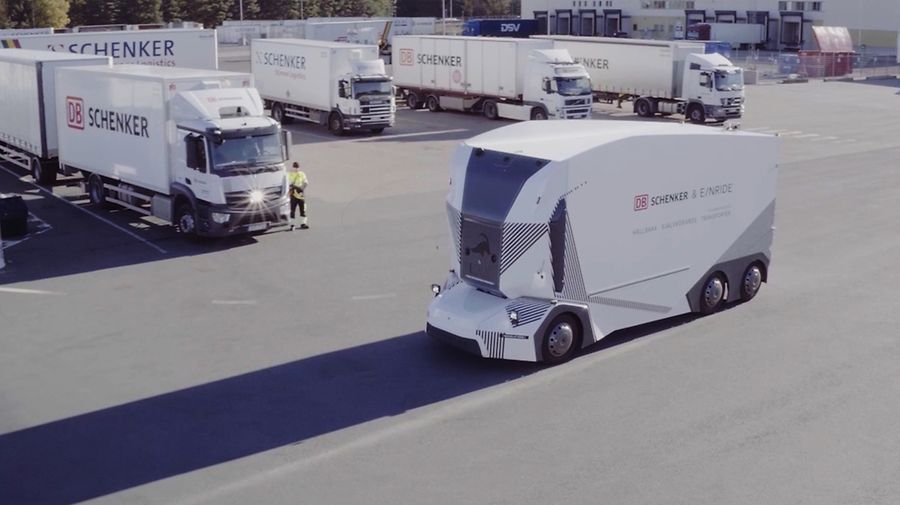
Above: Einride: T-Pod
Einride’s T-pod adopts a hybrid driverless way — on highways, the car is designed to pressure itself, but if it exits onto major town roads it switches to distant keep an eye on and a human takes over from afar. Those self same operators also are in a position to keep an eye on a number of pods on highways, must the location require it.
Einride’s first rent might be a former truck motive force who will retrain and learn how to keep an eye on a couple of vehicles from a distant room. The operator can even supply comments on construction of the corporate’s distant motive force station, informing the paintings setting of the next day to come’s truckers. This evolution provides a glimpse into how different jobs may shift as AI advances — industry-specific experience will most likely nonetheless be required even though task descriptions trade.
“As of late, our self sustaining pods are operated via builders — robotic engineers educated to pressure vehicles,” Einride CEO and founder Robert Falck mentioned. “A commercially scalable answer should depend on truck drivers, educated to remote-operate robots. The bits and bobs of that long term [are] what we’re investigating now, via involving truck drivers within the procedure.”
Giant industry
The worldwide truck transportation marketplace is pegged at $1.five trillion, making it a sizeable goal for disruption. Einride mentioned electrification and automation will permit it to optimize the street freight via decreasing gasoline and effort prices via 70%, reducing running prices via 60%, expanding productiveness via 200%, and decreasing Co2 emissions via 90%. Different corporations running within the self sustaining car distant help and tele-operations area come with Ottopia and Scotty Labs, which was once bought via DoorDash closing 12 months.
What some of these corporations display is that AI — for the foreseeable long term, no less than — would require people to supervise issues.
“AI will at all times need to be supervised,” Falck advised VentureBeat. “Independent cars will be the evident instance, the place I believe human tracking might be wanted for many future years, to lend a hand out in complicated eventualities. And we’ll want speedy response groups to accomplish repairs on damaged down robo-cars. We’ll want a wide variety of improve purposes that don’t exist these days. However this isn’t on the subject of practicality, it’s about ethical duty, which is a human assemble and a notoriously tough one at that.”
In an international filled with AI, people will most likely nonetheless be required throughout industries, whether or not for supervision, distant help, coaching, moral decision-making, or different enter.
“Philosophers distinguish between particular and tacit wisdom, tacit wisdom being tricky to switch verbally,” Falck endured. “So how do you translate it into code? Gadget studying might be mentioned to be a technique to that downside, however that’s not a clear procedure. So we’ll want individuals who can reconstruct selections made via self-learning machines, who can discover bias in self-learning algorithms, and so on. The very opacity of AI and the moral issues that go with the flow from that can generate new fascinating jobs.”


