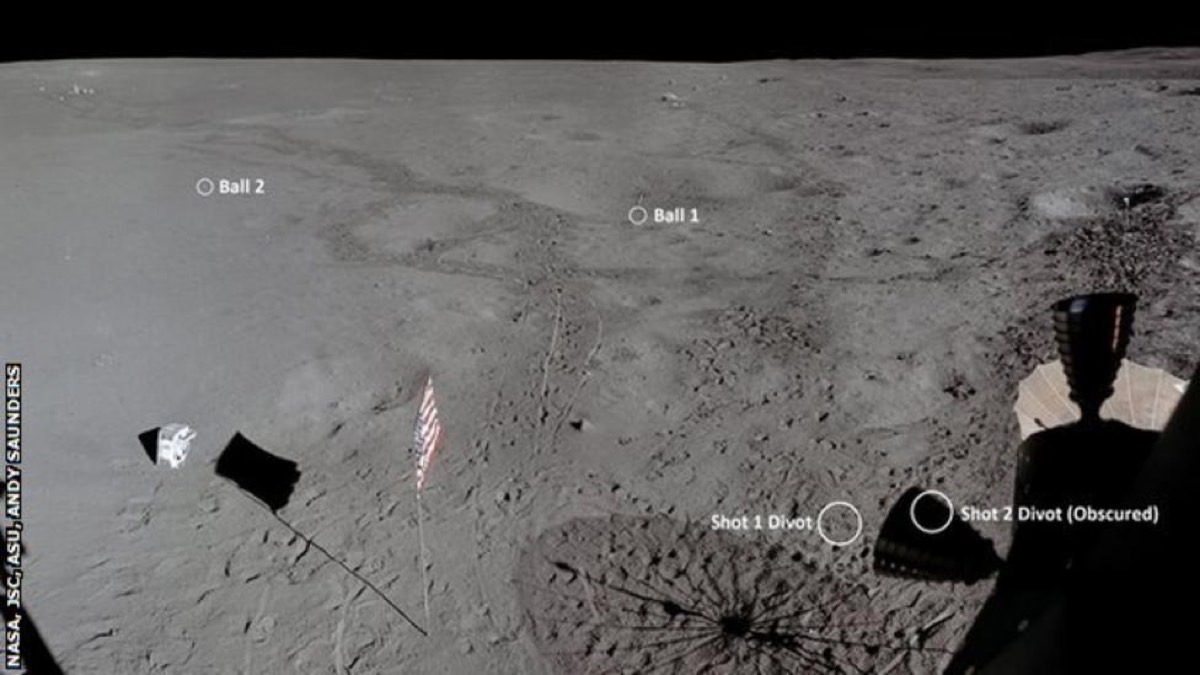
Fifty years in the past this week, NASA astronaut Alan B. Shepard Jr. made area historical past when he took a couple of golfing swings at the Moon all the way through the Apollo 14 challenge, effectively hitting two golfing balls around the lunar floor. Area lovers have debated for many years simply how a long way that moment ball traveled. It sort of feels we now have a solution, because of the efforts of imaging specialist Andy Saunders, who digitally enhanced archival pictures from that challenge and used them to estimate the general resting spots of the golfing balls.
Saunders, who has been operating with the USA Golfing Affiliation (USGA) to commemorate Shepard’s historic feat, introduced his findings in a Twitter thread. Saunders concluded that the primary golfing ball Shepard hit traveled more or less 24 yards, whilst the second one golfing ball traveled 40 yards.
Shepard’s fondness for cheeky irreverence had popped up every now and then all the way through his a hit pre-NASA naval occupation, maximum significantly when he used to be a check pilot on the Naval Air Station Patuxent River in Maryland. He used to be just about court-martialed for looping the Chesapeake Bay Bridge all the way through a check flight, however thankfully, his superiors intervened. When President Dwight D. Eisenhower established NASA in 1959, Shepard used to be decided on as some of the seven Mercury astronauts. (The others had been Scott Chippie, Gordon Cooper, John Glenn, Gus Grissom, Wally Schirra, and Deke Slayton.)
Shepard beat out some fierce pageant be selected for the primary American crewed challenge into area. Russian cosmonaut Yuri Gagarin famously changed into the primary guy in area on April 25, 1961, because of repeated postponements of NASA’s Mercury challenge, however Shepard wasn’t a long way at the back of. He made his personal flight into area one month later, on Would possibly five. Alas, he used to be a grounded after being identified with Ménière’s illness, leading to an strangely excessive quantity of fluid within the internal ear.
Surgical procedure 4 years later corrected the issue, and Shepard used to be cleared for flight. He narrowly ignored being assigned to the well-known Apollo 13 challenge—NASA’s “maximum a hit failure” and the topic of the 1995 Oscar-winning movie, Apollo 13 (one in every of my all-time faves). As a substitute, Shepard commanded the Apollo 14 challenge, which introduced on January 31, 1971, and landed at the Moon on February five.
To the Moon!
The speculation for Shepard’s stunt got here out of a 1970 discuss with through comic Bob Hope to NASA headquarters in Houston. An avid golfer, Hope cracked a shaggy dog story about hitting a golfing ball at the Moon, and Shepard idea it will be a very good way of conveying to other people observing again on Earth the adaptation within the energy of gravity. So he paid a professional named Jack Harden on the River Oaks Nation Membership in Houston to conform a Wilson Personnel 6-iron head in order that it might be hooked up to a collapsible aluminum and Teflon pattern collector. As soon as NASA’s Technical Services and products department added some completing touches, Shepard practiced his golfing swing at a route in Houston whilst dressed in his 200-plus-pound spacesuit to organize.
Hottest accounts describe Shepard as “smuggling” two balls and a golfing membership onto the spacecraft, however in keeping with a later interview with Shepard, that wasn’t the case. The astronaut ran the speculation previous then-NASA director Bob Gilruth, who used to be to start with antagonistic however relented as soon as Shepard laid out the suitable main points. Shepard additionally confident Gilruth that the stunt would simplest be finished as soon as the entire reputable exploration duties have been finished after which provided that the challenge had long past off with no hitch.
On February 6, Shepard introduced out the membership and two balls. His spacesuit used to be too cumbersome to make use of each fingers, so he swung the makeshift membership with simply his proper hand. After two swings that had been “extra grime than ball,” he made touch with the ball on his 3rd swing, “shanking” it into a close-by crater. (“Seemed like a slice to me, Al,” Apollo 13 pilot Fred Haise joked whilst observing from Challenge Keep watch over.)
However Shepard nailed his fourth strive. He despatched the ball hovering out of digicam vary and declared that it traveled for “miles and miles and miles.” And as he had expected, the spectacular 30-second time of flight completely showcased the adaptation in gravity between the Earth and the Moon. To not be not noted, crewmate Edgar Mitchell used a pole from a sun wind experiment as a javelin, which landed close to the primary golfing ball. As soon as again on Earth, Shepard donated his makeshift membership to the USGA museum and had a replica made this is now on show at the Smithsonian.
The positioning of the primary ball Shepard hit has been recognized for relatively a while—it is sitting in a crater subsequent to Mitchell’s javelin, about 24 yards from the place Shepard stood when he took his swing. Saunders’ remastering of archival footage enabled him to find the second one ball that traveled farther, in addition to some of the divots within the lunar soil.
“You’ll be able to get right of entry to Apollo imagery to very top quality on-line,” Apollo historian and video editor W. David Woods advised Ars. “Those photographs had been taken at 55 millimeters, the negatives and transparencies, for 55 millimeters an aspect. The scans they have got finished on them which are to be had on-line are 11,000 pixels throughout. So they are huge, large photos that you’ll in point of fact dive into, if you have got experience in symbol processing.”
Symbol tips
Saunders has that experience. He trusted fresh high-resolution scans of the unique flight movie, and he extensively utilized a method referred to as substacking, amongst others.
“Some stuff used to be shot the use of 16 millimeter film movie,” stated Woods. “Each and every person symbol is relatively small and grainy. However in the event you stack them one on most sensible of the opposite, you cancel out the grain, you cancel out the noise, and you are left with the imagery that is inherent in all the ones frames. It is a trick that astronomers use, the place they take rather a lot and a whole lot of photos of 1 house of the night time sky. They cancel out the noise through stacking the pictures in simply the similar method.”
The Apollo 14 team had taken a series of images from the window of the lunar module to seize the scene for posterity, which Saunders stitched in combination right into a unmarried landscape. In keeping with Saunders, given the recognized location of the TV digicam, it used to be conceivable to spot Shepard’s bootprints, appearing his stance for his first two (failed) makes an attempt. The usage of a recognized scale from pictures taken through the Lunar Reconnaissance Orbiter, he used to be then ready to measure the purpose between the divot and the second one golfing ball to get a hold of his estimate for 40 yards.
Saunders, whose imminent ebook is entitled Apollo Remastered, estimates that a skilled US Open golfer like Bryson DeChambeau may just, in idea, hit a ball so far as three.41 miles at the Moon, with a dangle time of one minute 22 seconds—a lot farther (and longer) than Shepard’s feat. As he advised the BBC:
Sadly, even the spectacular moment shot may just hardly ever be described as “miles and miles and miles,” however after all this has simplest ever been considered a light-hearted exaggeration. The Moon is successfully one massive, unraked, rock-strewn bunker. The pressurized fits significantly limited motion, and because of their helmet’s visors they struggled to even see their ft. I’d problem any membership golfer to visit their native route and take a look at to hit a six-iron, one-handed, with a one-quarter swing out of an unraked bunker. Then believe being absolutely suited, helmeted, and dressed in thick gloves. Keep in mind additionally that there used to be little gravity to tug the clubhead down towards the ball. The truth that Shepard even made touch and were given the ball airborne is very spectacular.
And naturally, the astronaut’s legacy as the primary human to play golfing at the Moon stays safe.